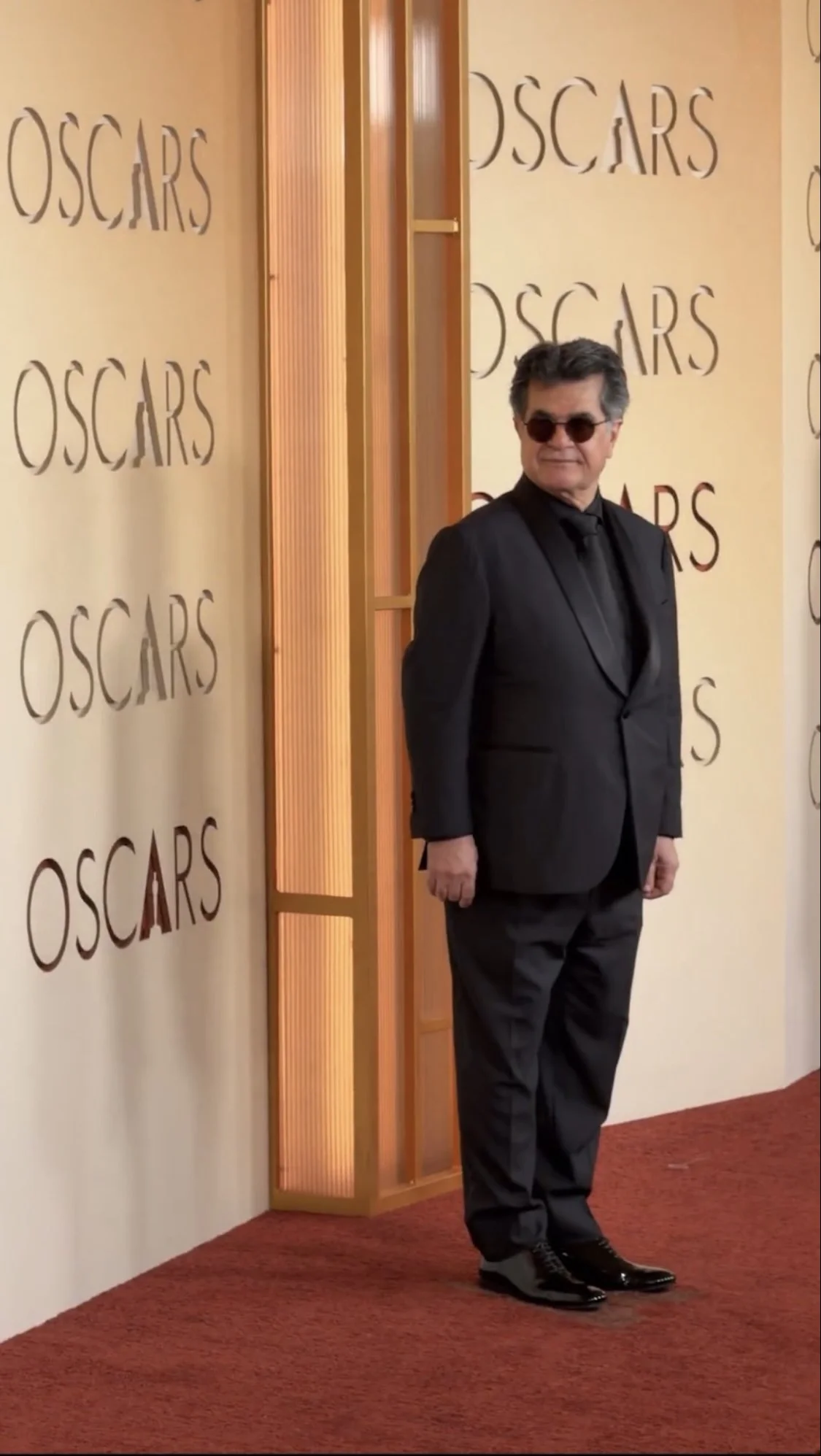
The eyes of Jafar Panahi: a cinematic “accident”
Last night, the Academy Awards were presented at the Dolby Theater in Hollywood. On the red carpet beforehand, multimillionaire businessman and television personality Kevin O’Leary posed for photographers while wearing a silver-trimmed kimono and diamond-encrusted glass frame that appeared to be displaying NBA player trading cards. He was at the ceremony because of his role in Josh Safdie’s Marty Supreme — a drama about ping-pong competitions in 1950s New York City. Though a regular on reality TV programs, this was Mr. O’Leary’s first appearance in film; he has since posited that he would like to return to the big screen, perhaps as a Bond villain.
As Mr. O’Leary brandished his jewelry, he was watched from a little further down the carpet by lauded neorealist Iranian filmmaker Jafar Panahi, who was nominated for writing and directing the absurdist political thriller It Was Just an Accident. Mr. Panahi is one of the greatest filmmakers of our time; his movies tackle sociopolitical realities of contemporary Iran with sanity, humor and pathos. His films are frequently produced in secret, so as to avoid censorship or suppression from his nation’s government.
It was a marked contrast, glimpsing Mr. O’Leary in his prepubescent mania for attention, flashing teeth and trinkets to a wall of lenses, beside Mr. Panahi’s steady, baffled composure. The great artist looked upon the great personality as a sort of aberration — as a grotesque, as a vaguely incomprehensible spectacle. It was the look one gives a derelict charging down the sidewalk shouting profanities into the air. Amused, yet repulsed.
His view of Mr. O’Leary — both literal and subjective — constitutes perhaps the most cinematic moment of the last year. An evening designed to celebrate the best in visual-narrative storytelling yielded a more poignant, multilayered graphic of global society in this random pairing of its own guests than did any of the feature-length or short films it chose to honor.
Of course, the reason for this is that Mr. Panahi is a great observer: he looks at the world, he looks at people, and his look is conveyed to us via his films or his face. He understands what he sees, and relates his understanding to us in terms that provoke as much as they make sense.
He is striking on that red carpet. He is still in a scene that is rampant with chaos. His view of Mr. O’Leary, his look at him, tells us more about the future of cinema that either Marty Supreme or It Was Just an Accident. Those films are merely figments of the people who made them; we learn more by placing their people, or their makers, next to one another, and by inviting ourselves to ask whose view, or whose look we’d rather see.