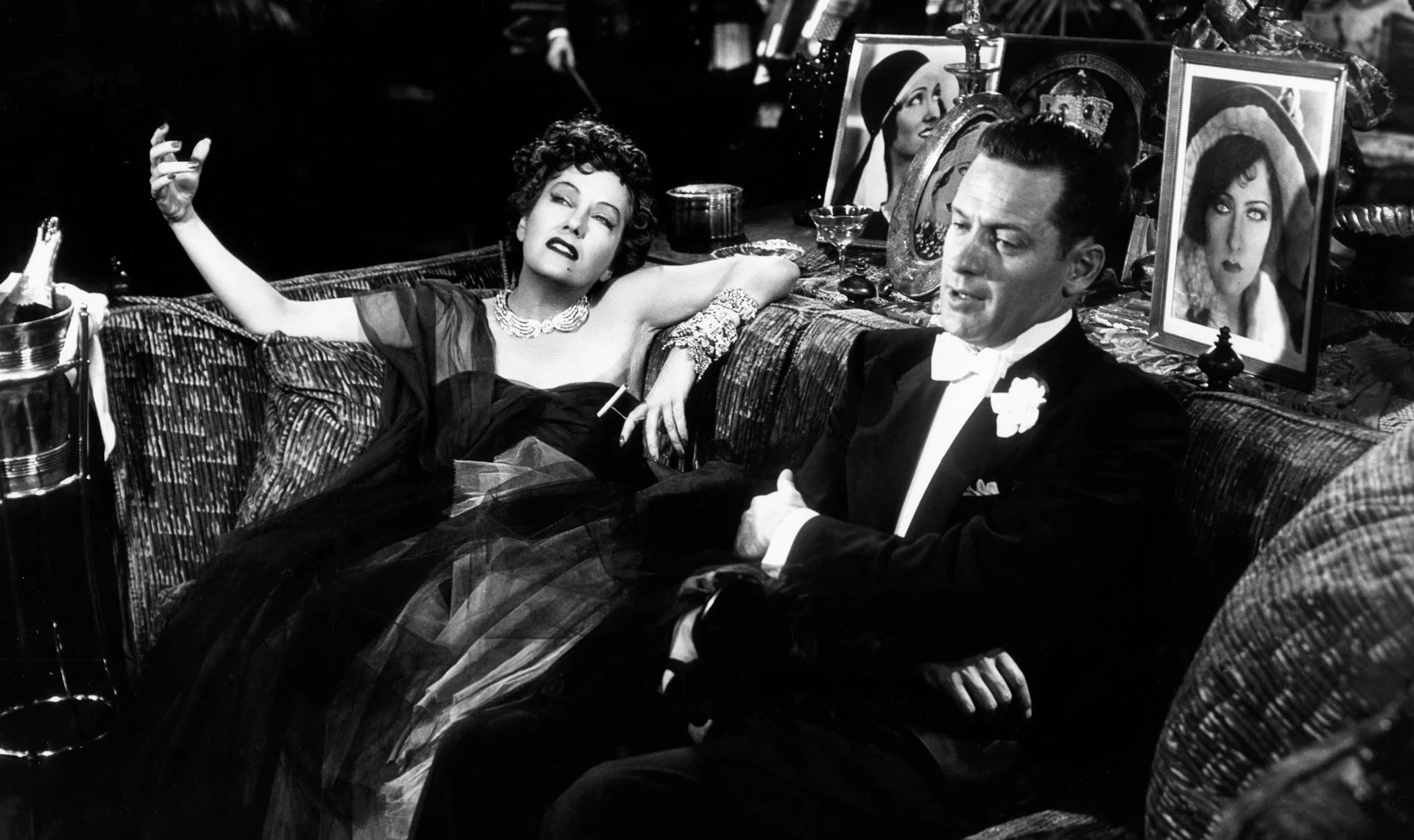
Old movies have always been around. That’s what’s so handy about them.
When I first saw Sunset Blvd, as a teenager, I thought it was so-so. Then, when I was twenty, I watched it again: I was on a plane back home from Italy — I’d just seen Rome, Florence, Pompeii. It was a long return flight, so I cued up a triple screening: Sunset Blvd, Annie Hall, and Adaptation.
Movies about writers. Movies about obsession.
Something about the (literally) elevated, worldly mindset in which I sat at that moment gave me a greater affection for this film in particular. It also granted me a keener eye. After all, I was a devotee of co-writer and director Billy Wilder’s other flicks: Some Like It Hot had been formative; The Apartment, comfortable; and Sabrina communicated the romantic yearning of my adolescence better than any other movie.
So I decided to give Sunset Blvd the benefit of the doubt. I now thought of it as a shrewd if somewhat hokey venture into showbiz cynicism. I’d learned by then — and I think this way still — to be wary of Mr. Wilder’s brand of jadedness. He had a way of being too clever by half while completely missing the deeper implications of the subjects he skewered.
It’s like he took much fun in wriggling in the poker, such that he never noticed the meat he was impaling hadn’t stopped pulsing.
In the years since, I’ve rewatched Sunset Blvd from time to time, and, this past December, I went to see Todd Haynes’ Carol at the Community Theater in Catskill and thus saw a fragment of Norma Desmond’s (Gloria Swanson) New Year’s Eve party, which, at one point, Rooney Mara and John Magaro find themselves spectating from a projection booth.
How tickled was I to realize, today, that I was sitting down to watch Norma and company again at the very same theater. (At this rate I’m going to have to see Queen Kelly in Catskill, too.)
At this screening, I cried. I didn’t expect that. Norma got me; she’s continued to get me more and more as the years have gone by. That fluttering voice — round and sumptuous, yes, but also warbling. Frightened. Her broadness, the comedic camp of Gloria Swanson’s gestures are rooted in painful self-destruction. Norma Desmond clings to fantasy because it what she’s always used to survive — except that, now, it’s got the better of her.
She’s so pathetic, so earnest. And I so get it.
Last night, I was having a conversation with a new-ish friend whom I happen to know has, as one says, “feelings” for me. At first I knew this intuitively; then — earlier this week, after he sent me a long, confessional text message — I knew it literally.
We were talking a lot about yearning and desire. About wanting to be wanted. He kept gazing into my eyes — keeping a straight face, smiling. But I knew how he felt. He’d told me. And we both knew that I wasn’t going to give him what he wanted.
That was less than twenty-four hours ago. The more I’ve thought about our conversation, which was charming enough on the surface — kind, transparent, encouraging even — the more I’ve thought about it, the more I’ve been troubled by a sense that, on some level, I was being placed in a compromising position.
It felt as though I was being made to answer for myself. As if he’d been silently demanding: “Explain to me why you don’t love me.”
How jarring, then, to watch Ms. Desmond — upon being rejected by her washed-up screenwriter of a houseboy, Joe (William Holden) — cry out: “What you’re trying to say is you don’t want me to love you!”
And I suddenly saw all the years that I’d wanted people to want me. I saw all the fantasy that I had once used to sustain myself — and how, in adulthood, that fantasy led me to neglect everything that was right in front of me. I, like Norma, had let the weeds grow. I, too, had stashed my car in the garage, mounted it on cinderblocks, and allowed rats to run rampant across the tiled floor of my drained swimming pool.
Sometime between that twenty-year-old’s journey from Italy and my present residence in the Hudson Valley, I’d learned to keep house. It’s not the Ritz, to be sure, but it’s home. I think I know now how to be honest with myself.
Here’s the truth: I had to learn this. I’ve had to earn my keep. That’s something that Holden’s Joe avoids doing, it’s something that Ms. Desmond enables until she decides she’d rather see her boytoy dead. He has a chance, of course, to go “straight” — first, when his agent encourages him to give up his car (“Best thing that could ever happen to you!”) and second, when he has the option to leave the “queer” world of Norma’s decaying palace and pair up with Betty, his twenty-two-year-old writer partner (the marvelous Nancy Olson). But he hates himself, or decides to hate himself, or prefers to be cynically detached. He chases Betty away so that Norma can shoot him in the back.
I understand the Joes of this world, I do; I sympathize with the Normas; and I think Mr. Wilder did, too.